Generative AI glossary 2026: image, video, music, language models and the law
How image, video, music and language models work, what they are trained on, how their output is labelled, and what the 2026 European and Hungarian regulations require. A professional glossary with algorithms, diagrams and 2026 data.
What is this glossary about?
By 2026, generative artificial intelligence has become an everyday tool of content production, yet the knowledge around it is scattered: technical descriptions live in English and in research papers, legal rules in regulations and court rulings, platform policies on help pages. This article gathers in one place what a client, a marketer or a creator should know: how image, video, music and language models work (with algorithms), what they are trained on and how the data is labelled, how the output is marked, what the EU AI Act requires from 2 August 2026, where Hungarian regulation and court practice stand, and how an AI search engine chooses its sources.
All statistics and market data come exclusively from 2026 sources; for the core algorithms, the name and year of the classic paper is given. How all of this looks in our own production practice (what we generate, what we do not, how a trained filmmaker works with the models) is described on the AI content production service page.
How do image generation models work?

Diffusion model: from noise to image
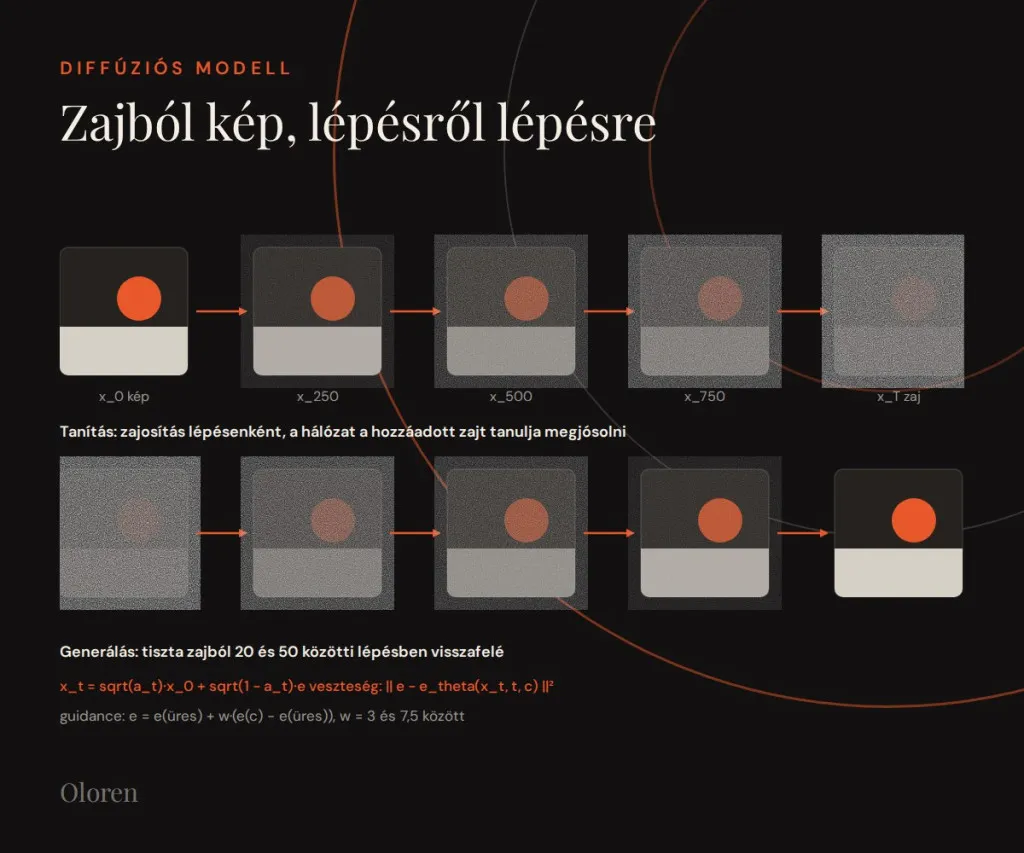
Most image generators used in 2026 work on the diffusion principle (DDPM, Ho et al., 2020). During training, the model adds more and more random noise to a clean image step by step until the image turns into pure noise, and along the way it learns to predict how much noise is present in the image at a given noisy state. At generation time the process is reversed: we start from pure noise, and the network removes the predicted noise step by step until only an image remains.
The training step of the algorithm: x_t = sqrt(a_t) * x_0 + sqrt(1 - a_t) * e, where x_0 is the clean image, e is the noise and a_t is the noise schedule; the network minimises the loss || e - e_theta(x_t, t, c) ||^2, where c is the text condition. At generation time (DDIM sampling), 20 to 50 steps are enough instead of the original 1000.
The strength of the prompt is controlled by classifier-free guidance: the network runs twice, with and without the condition, and the difference between the two is amplified by a factor w (e = e(empty) + w * (e(c) - e(empty))). A higher w gives a more faithful but less varied and easily oversaturated image; in practice, values between 3 and 7.5 are typical.
Latent space: the compressed form of the image
Diffusion does not run on the pixels but in a compressed representation (latent diffusion, Rombach et al., 2021). A variational autoencoder (VAE) compresses the 512×512×3 pixel image into 64×64×4 values, that is, eight times smaller per side and roughly 48 times fewer numbers in total. Noising and denoising happen in this latent space, and at the end the VAE decoder reconstructs the pixels.
This is what allows a model with several billion parameters to run on a single graphics card, and this is why the model family is called latent diffusion. The latent space is continuous: interpolating between two points produces meaningful intermediate images, which is the basis of variations, image-to-image transformation and inpainting (regenerating part of the image along a mask).
Text encoder and cross-attention: how the prompt gets into the image
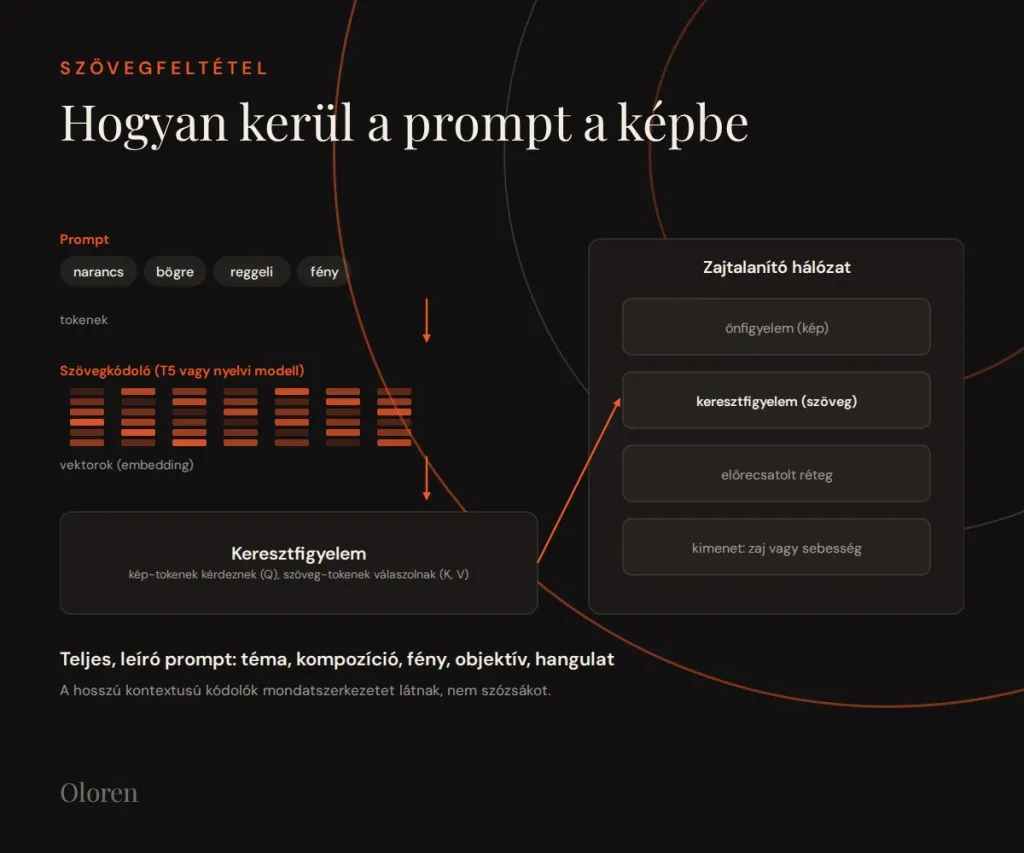
The prompt is first split into tokens, then a text encoder (CLIP in the early models, today T5 or a language model) assigns a numeric vector to each token. These vectors are fed into the attention layers of the denoising network: the image tokens "ask" (query), the text tokens "answer" (key, value), so for every part of the image the network knows which word applies to it.
Image quality in text rendering and complex compositions has improved so visibly since 2024 because the short, 77-token CLIP encoder was replaced by long-context language models: the model no longer sees a bag of words but sentence structure. This is why in practice we write a full, descriptive prompt (subject, composition, light, lens, mood) rather than a list of keywords.
Flow matching and diffusion transformer
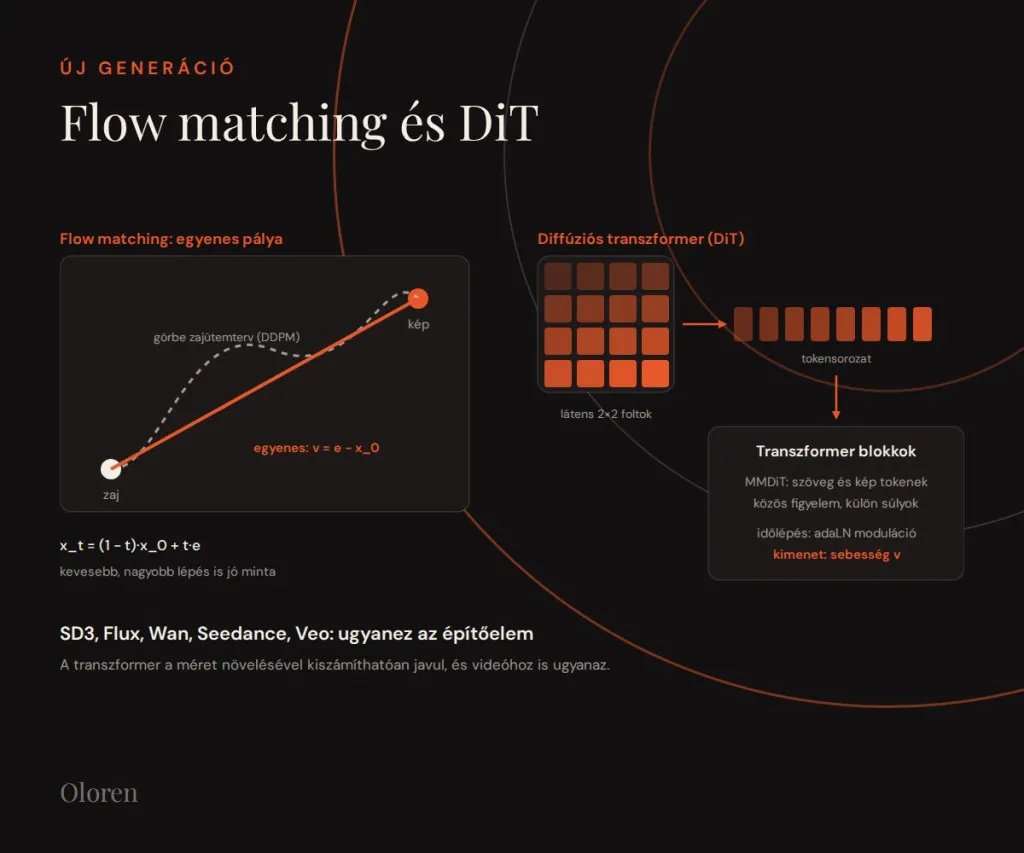
The image and video models of 2025 and 2026 (Stable Diffusion 3, Flux, Wan, Seedance, Veo) brought two innovations. Flow matching (Lipman et al., 2022) draws a straight line between the image and the noise instead of a curved noise schedule, and the model learns the velocity along this line: x_t = (1 - t) * x_0 + t * e, target v = e - x_0. Thanks to the straight path, fewer and larger steps still yield a good sample.
The diffusion transformer (DiT, Peebles and Xie, 2022) replaces the earlier U-Net: it cuts the latent image into 2×2 patches, turns them into a token sequence and processes them with a standard transformer. The MMDiT variant (SD3, Flux) handles text and image tokens in a shared attention block but with separate weight sets, so the two modalities communicate in both directions. The advantage of the transformer is that it improves predictably as it scales, and the same building block also serves for video.
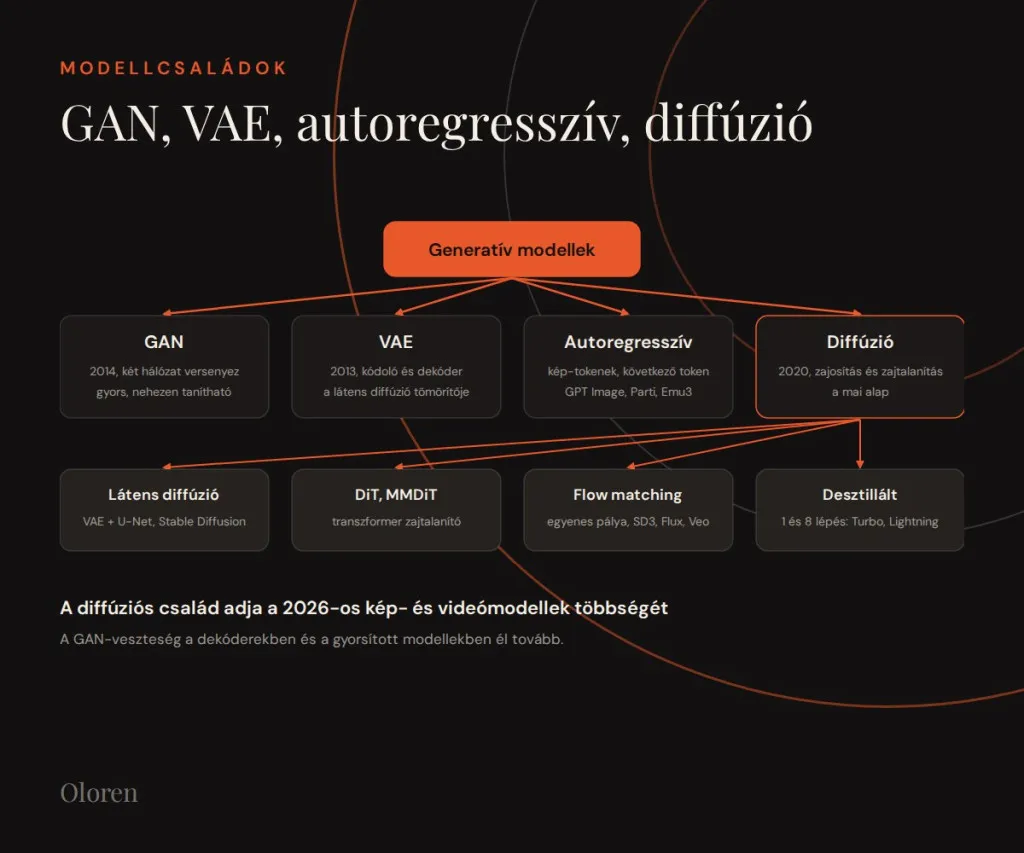
GAN, VAE, autoregressive: the other model families
GAN (Goodfellow et al., 2014): two networks compete, the generator produces images and the discriminator tells real from fake. It generates in a single step, so it is fast, but hard to train; today it lives on as an internal loss in VAE decoders and in accelerated, few-step models.
VAE (Kingma and Welling, 2013): an encoder and a decoder with a regularised latent distribution in between. On its own it produces blurry images, but it is the compression stage of latent diffusion.
Autoregressive token model (VQ-VAE, VQGAN, Parti, Emu3): it breaks the image into integers of a learned codebook, and a language model predicts the next image token just as it predicts the next word. OpenAI's GPT Image line works on this principle too, an image generator built natively into the language model: it writes exact text onto the image and supports multi-turn editing, at the cost of slower, sequential decoding.
Consistency and distilled models (Song et al., 2023): a "student" learns to imitate the output of a multi-step "teacher" model in 1 to 8 steps. These are the Turbo, Lightning and Fast variants that deliver a preview within seconds.
Diffusion generation step by step
In practice, a text-to-image generation consists of the following steps. 1. Tokenisation: the prompt is turned into a token sequence. 2. Encoding: the text encoder assigns a vector to each token. 3. Initialisation: random noise is drawn in the latent space (the "seed" is its starting point, which is why the same image can be reproduced with the same seed). 4. Denoising loop: in 20 to 50 steps the network predicts the noise or the velocity, guidance amplifies the effect of the prompt, and the sample moves one step closer to the clean image. 5. Decoding: the VAE produces pixels from the latent values. 6. Post-processing: safety filter, invisible watermark (for example SynthID), signed provenance data (C2PA), upscaling.
What matters from this in production: fixing the seed and the step count makes the result reproducible; the guidance value is the trade-off between fidelity and variety; the size of the latent space (1K, 2K, 4K output) determines both the level of detail and the runtime; and the watermark and provenance data are the technical basis of the 2026 labelling obligation.
What are the models trained on, and how is the data labelled?
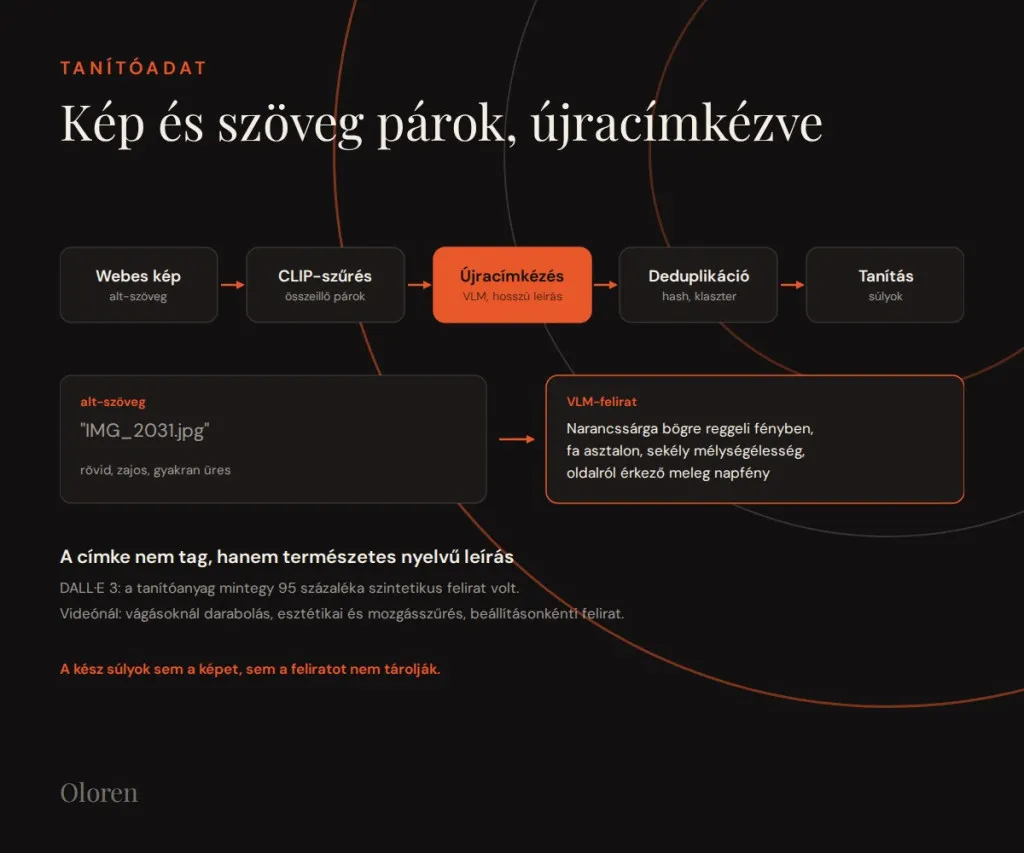
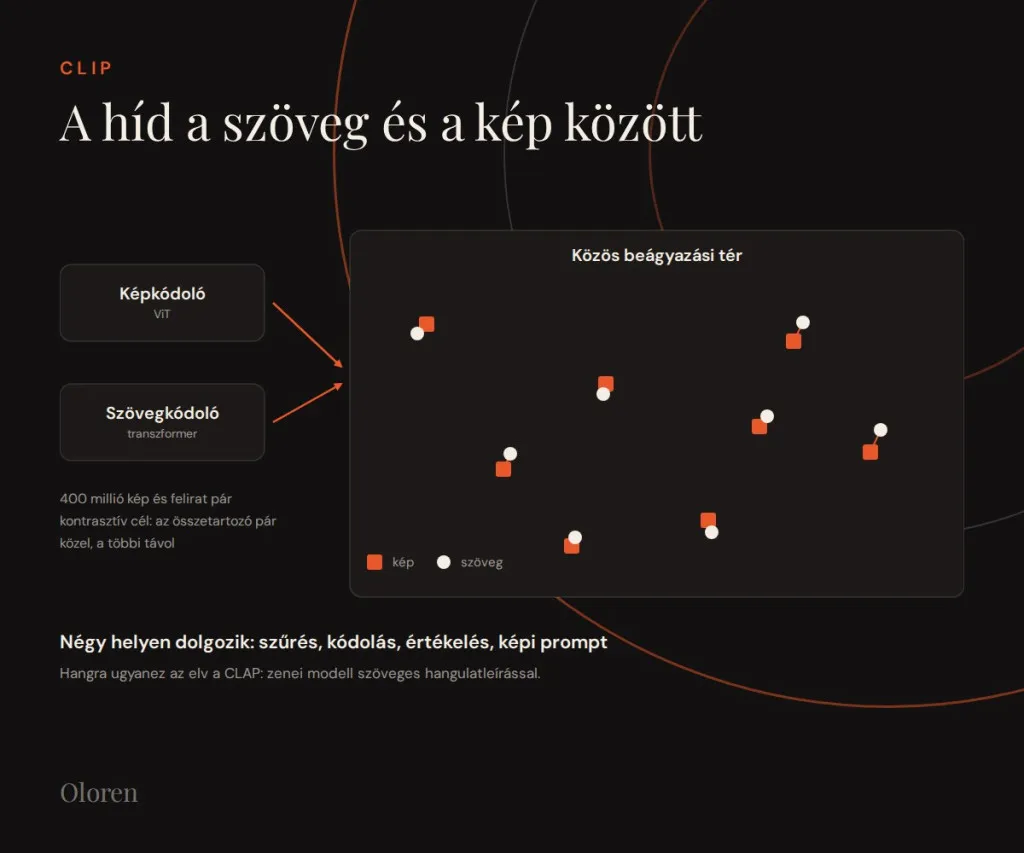

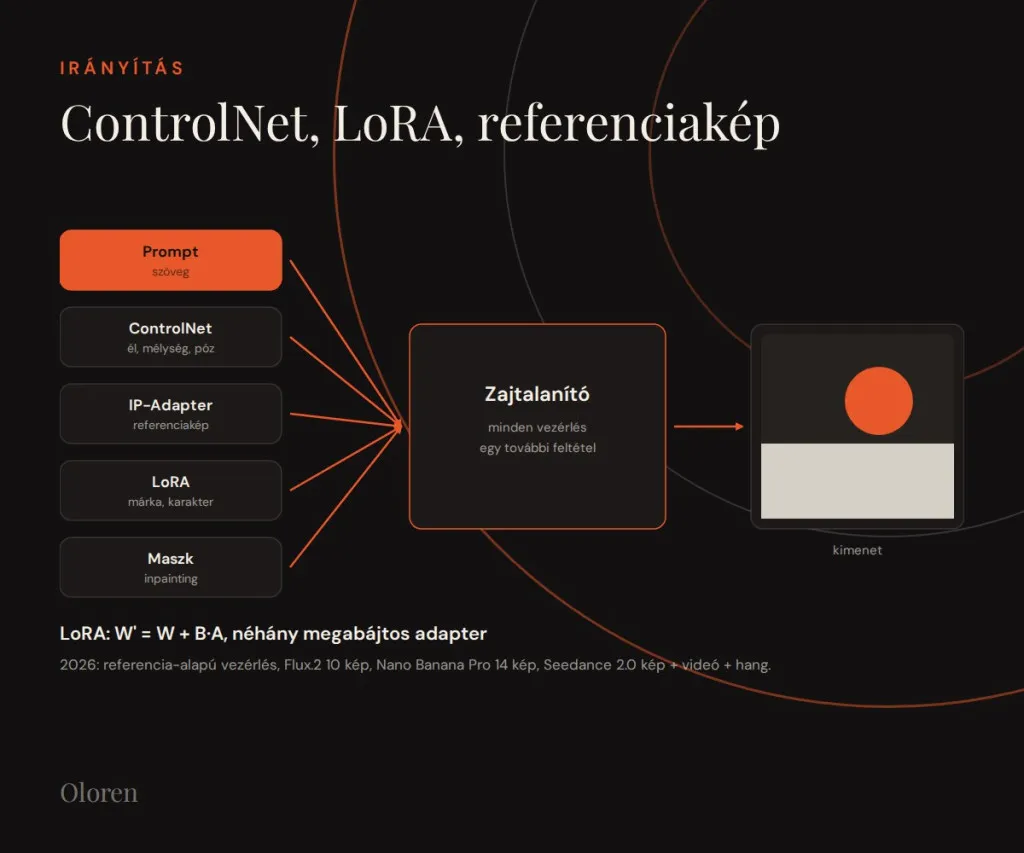
Image and text pairs: the training data
The training material of image models consists of image and text pairs. The public datasets (for example LAION-5B with 5.85 billion pairs) come from web scraping: the page's alt text is attached to the image, then a CLIP similarity threshold filters out mismatched pairs. Alt text is short and noisy, which is why labs now re-caption: a vision-language model (VLM) writes a long, detailed description for every image. According to OpenAI's DALL·E 3 documentation, about 95 percent of the training material consisted of such synthetic captions, and this is what delivered the better prompt adherence.
For video, the clips are split at cuts, run through aesthetic, motion and text filters, then captioned per shot. The label is therefore not a "tag" in a database but a natural-language description from which the model learns the joint distribution of text and visuals. The model stores neither the image nor the caption in its final weights.
CLIP: the bridge between text and image
CLIP (Radford et al., 2021) trains two encoders at once, an image encoder and a text encoder, on 400 million image-caption pairs with a contrastive objective. The vectors of a matching image and text end up close to each other in a shared space, those of non-matching ones far apart. This simple principle works in four places in today's systems: in filtering the training data, as the text encoder of the early models, in evaluating the output (CLIP score), and as the input of image prompts (IP-Adapter, reference image).
The same idea works for audio as well (CLAP), which is why a music model can be steered with a textual mood description.
Weights, not files: why the model does not collage images
Training does not copy; it sets the parameters (weights) of the network so that the denoiser predicts the direction of the training distribution. The sizes speak for themselves: a 32-billion-parameter image model (Flux.2) is roughly 64 gigabytes in half precision, while the training images amount to several hundred terabytes. The dataset physically does not fit into the weights, so the model cannot "look up" a file.
Memorisation still exists, but it is rare and concentrated on duplicates: Carlini et al. (2023) found about a hundred outputs nearly identical to a training image out of 175 million attempts with Stable Diffusion, typically for images repeated many times. Labs respond with deduplication, caption diversification, filtering of famous works and persons, and output similarity checks. From a legal perspective, however, this very memorisation is at the centre of the European rulings of 2025 and 2026, which we cover in the legal chapter.
Control: ControlNet, LoRA, reference image
Professional use is decided not in the prompt but in the conditions. Every control adds a further signal to the denoiser. Image-to-image (SDEdit): the input image is partially noised and the process continues from there, with the strength determining how much of the original remains. Inpainting and outpainting: only the selected region along the mask is regenerated. ControlNet (Zhang et al., 2023): feeds an edge, depth or pose map through a parallel network branch, so the composition can be locked while the style stays free. IP-Adapter: the CLIP vector of a reference image arrives through a separate attention branch, this is the "image prompt". LoRA (Hu et al., 2021): instead of rewriting the model's weights, a low-rank addition is trained (W' = W + B·A), an adapter of a few megabytes for a product, a character or a brand style. DreamBooth: binds the subject to a rare token from 3 to 5 photos.
The top models of 2025 and 2026 simplify this into reference-based, in-context control: Flux.2 retains up to 10 reference images, Nano Banana Pro up to 14 (the identity of 5 persons), Veo 3.1 has "Ingredients", Kling 3.0 has "Elements", and Seedance 2.0 accepts image, video and audio as references. This is what makes the consistency of brand elements, the product and the character possible from shot to shot.
Video generation: time is the third dimension
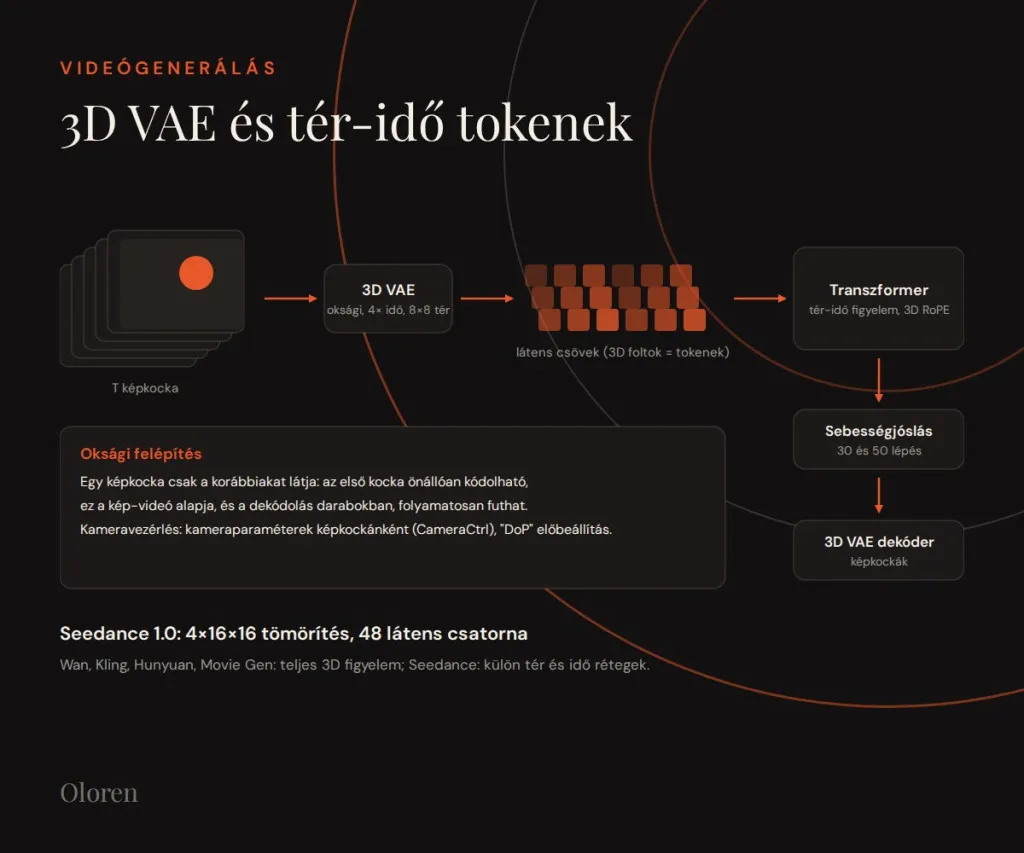
3D VAE and space-time tokens
A video model uses the same latent diffusion principle, extended with time. A 3D causal VAE compresses the frames in both space and time: Wan 2.1 by a factor of 4 in time and 8×8 in space, Seedance 1.0 at a 4×16×16 ratio with 48 latent channels. Because of the causal design, a frame only sees the frames before it, so the first frame can be encoded on its own, which is the basis of image-to-video.
The latent video is cut into 3D patches, "tubes" (for example 1×2×2 latent voxels per token), every token receives a 3D positional code (time, y, x), and then a diffusion transformer processes it together with the text tokens using full spatio-temporal attention (Wan, Kling, Hunyuan Video, Movie Gen) or separate spatial and temporal attention layers (Seedance 1.0). The output is computed with flow matching velocity prediction in 30 to 50 steps, or in a few steps when distilled, and finally the 3D VAE decoder returns the frames. For camera control, the camera parameters are encoded per frame as Plücker rays (CameraCtrl, 2024), which appears in products as "director" or "DoP" presets.
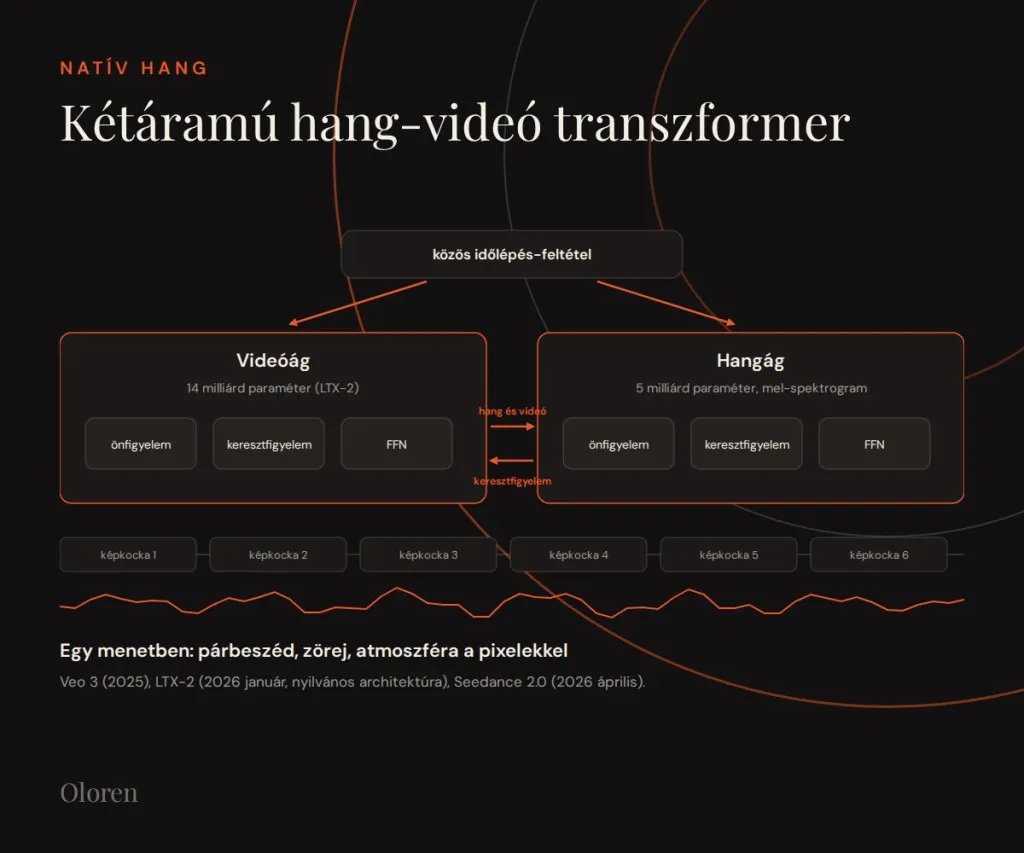
Native audio and multiple shots in one generation
Veo 3 (May 2025) was the first widely used model to produce dialogue, sound effects and atmosphere together with the pixels in a single pass. The public architecture for this is LTX-2 (Lightricks, January 2026): an asymmetric, two-stream transformer with a 14 billion parameter video branch and a 5 billion parameter audio branch (mel spectrogram latent, one token roughly 1/25 of a second), the two connected by bidirectional audio-video cross-attention with a shared timestep condition. Seedance 2.0 (April 2026) accepts text, image, audio and video references in a unified audio-video generation.
Longer, multi-shot material is produced in three ways: the model continues from the last second of the previous clip (Veo 3.1 "extend"), it natively learns multiple shots with per-shot positional encoding and a storyboard-level prompt (Seedance, Kling 3.0 Omni), or it handles a longer context in a single pass (Wan 3.0 and Seedance 2.5: 30 seconds). The identity of characters and objects is kept from shot to shot by reference binding ("Elements", "Ingredients").
Video models available in 2026
The table summarises the capabilities publicly documented in September 2026. The values are the vendors' own statements, the models change quickly, so we always re-verify them when a project starts.
| Model | Length and resolution | Audio | Worth knowing |
|---|---|---|---|
| Google Veo 3.1 | 4, 6, 8 s, 1080p, 4K with upscaling | native dialogue, sound effects, music | "Ingredients" references, first and last frame, scene extension, SynthID watermark on every output |
| Kling 3.0 and 3.0 Omni | between 3 and 15 s, 720p, 1080p | native, multilingual | multi-shot storyboard, "Elements" image and video references, released February 2026 |
| ByteDance Seedance 2.0 and 2.5 | 4 and 15 s, version 2.5 30 s | multi-track: music, atmosphere, speech | up to 9 image, 3 video and 3 audio references, unified audio-video architecture |
| Runway Gen-4.5 and Aleph 2.0 | between 2 and 10 s, 720p; Aleph up to 30 s at 1080p | not native, ElevenLabs integration | first place in the independent ranking in December 2025; Aleph for in-context editing of real footage |
| Alibaba Wan 2.x and 3.0 | 2.6: 1080p, 15 s; 3.0: 30 s in a single pass | native audio-video sync | Wan 2.1 with open weights (Apache-2.0), 3.0 API only |
| Luma Ray3 | 1080p native, 4K with upscaling | no native audio | 16-bit HDR (EXR) output, an advantage in colour management |
| OpenAI Sora 2 | 1280×720 | synchronised | OpenAI discontinued the Sora app on 26 April 2026 and the API on 24 September 2026 |
Image models in 2026: Google Nano Banana Pro and Nano Banana 2 (1K, 2K, 4K, up to 14 reference images, SynthID), OpenAI GPT Image 2 (April 2026, generation built natively into the language model), Black Forest Labs Flux.2 (32 billion parameters, open dev weights), Midjourney V8.2 (July 2026), Ideogram 4.0 (June 2026, open weights, typography), ByteDance Seedream 5.0 Pro (July 2026, separation into 20 layers), Stability AI Stable Diffusion 3.5.
Music and audio generation AI: technology and regulation
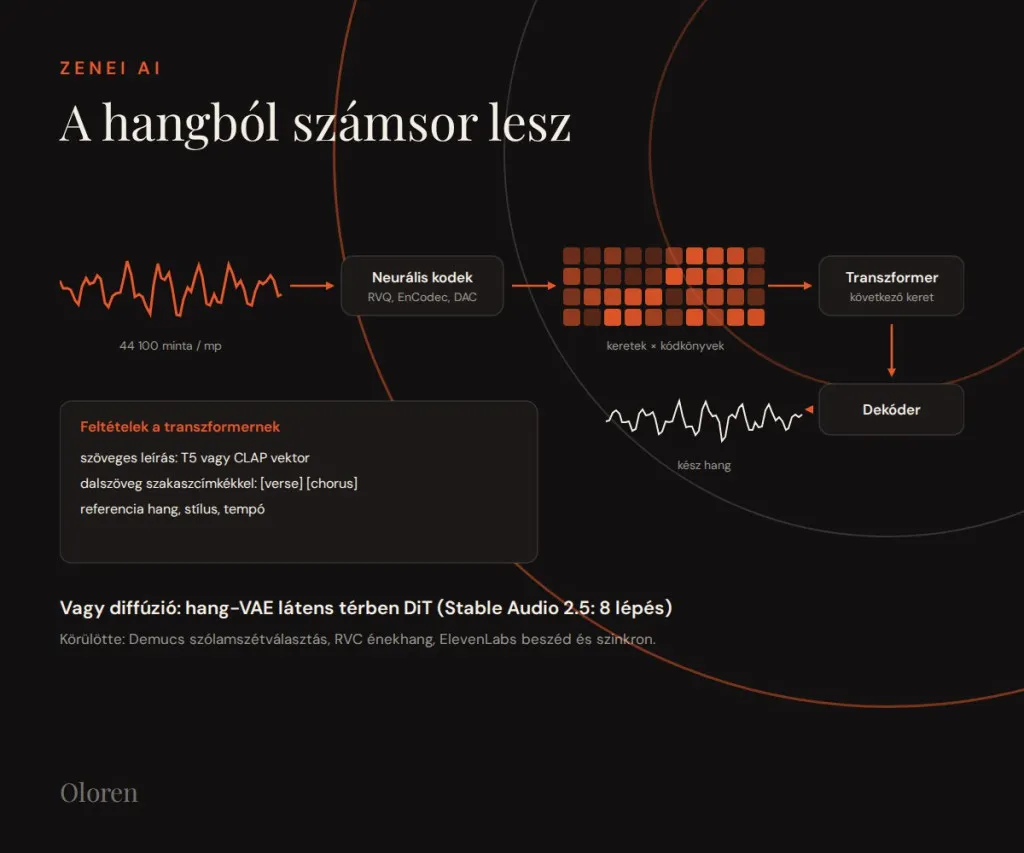
Codec tokens: sound becomes a sequence of numbers
Raw audio consists of 44,100 samples per second, which is far too long for a transformer. Music models therefore compress the waveform with a neural codec (SoundStream, EnCodec, DAC) into a few dozen "frames" per second, and each frame receives a few integers from learned codebooks (residual vector quantisation). From there, two paths exist. Autoregressive models (MusicLM, MusicGen, and the publicly documented song models such as YuE or HeartMuLa) predict the next audio frame with a language model; the text description enters as a T5 or CLAP vector, and the lyrics are tokenised with section tags ([verse], [chorus]). Latent diffusion models (AudioLDM, Stable Audio 2.0 and 2.5) run a diffusion transformer in the latent space of an audio VAE; Stable Audio 2.5 delivers three minutes of music in eight steps, in under two seconds.
The architecture of the commercial systems (Suno, Udio) is not public. Around them sits the broader audio AI: stem separation (Demucs), voice cloning and singing voice conversion (RVC, ElevenLabs), text-to-speech, and AI dubbing, which translates the speech, re-synthesises it in the cloned voice and aligns it with the lip movement.
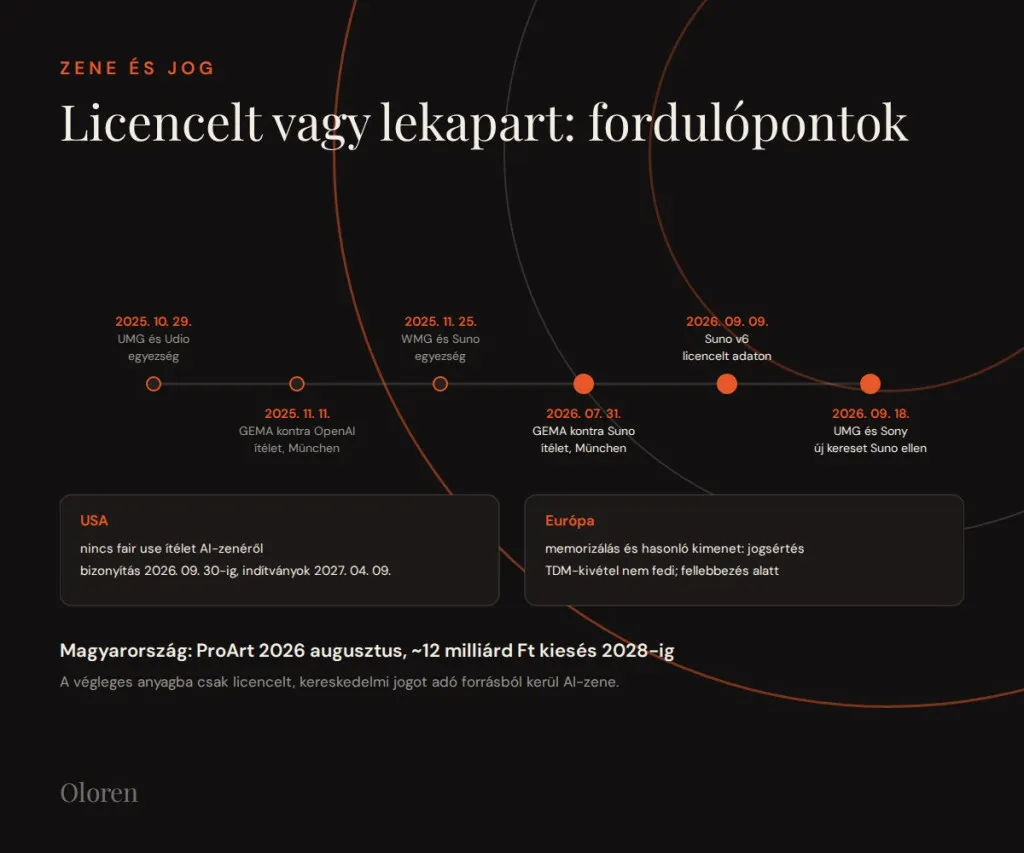
Licensed or scraped: the turning points of 2025 and 2026
The legal map of generative music AI was redrawn in 2026. Universal reached an agreement with Udio on 29 October 2025, Warner on 19 November 2025, and Warner with Suno on 25 November 2025; on 9 September 2026 Suno released the v6 model family, which according to its own statement was trained on material licensed from Warner, BMG and Believe. At the same time, Universal and Sony filed a new lawsuit against Suno on 18 September 2026 over 60,202 sound recordings, Sony against Udio on 20 July 2026, and there is still no ruling on the US fair use question: in the Suno case, discovery closes on 30 September 2026 and the deadline for dispositive motions is 9 April 2027.
The situation in Europe is different. On 11 November 2025 the Munich Regional Court ruled in favour of GEMA against OpenAI (memorising lyrics in the weights is reproduction, not covered by the text and data mining exception), and on 31 July 2026 against Suno as well: training, memorisation, output and communication to the public are all infringing, and it rejected the US fair use argument. Both cases are under appeal. In Hungary, ProArt's music industry report from August 2026 projects a loss of around 12 billion forints in the royalties of Hungarian composers and performers by 2028 because of AI music.
Platform rules 2026: labelling, exclusion, bans
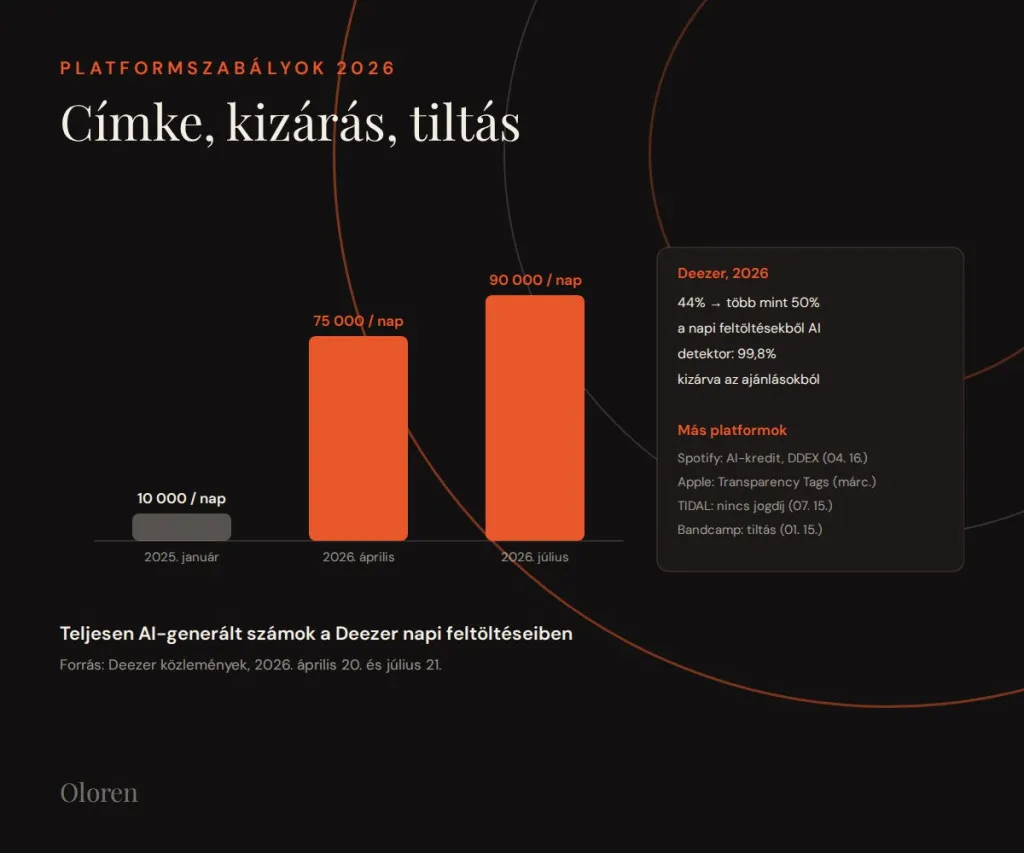
According to Deezer's statement of 20 April 2026, 44 percent of daily uploads (around 75,000 tracks per day) were fully AI-generated, and in July 2026 this passed 50 percent (roughly 90,000 tracks per day); the platform excludes AI tracks from algorithmic and editorial recommendations, and its detector is 99.8 percent accurate according to its own statement. From 16 April 2026 Spotify shows AI labelling in the credits according to the DDEX standard, bans unauthorised voice clones and works with a spam filter; from March 2026 Apple Music asks for "Transparency Tags" self-declaration; from 15 July 2026 TIDAL excludes fully AI-generated tracks from royalty distribution; from 15 January 2026 Bandcamp bans music made entirely or substantially with AI.
For advertising and content production the conclusion is simple: AI music in final material only from a licensed platform, from a plan that grants commercial rights, with documented terms; as a mood reference, temporary music (temp track) and sound design sketch, however, it is the fastest tool. We do not clone the voice or style of a real artist, the platforms ban this regardless of labelling.
Language models: how ChatGPT, Gemini and Claude work

Tokenisation: a Hungarian word splits into several pieces
A language model does not see words but tokens: pieces of a vocabulary of between 32,000 and 260,000 items. Byte-pair encoding (BPE) merges the most frequent adjacent character pairs until the vocabulary is full; SentencePiece learns on raw text without whitespace pre-processing. Since the vocabularies are built mainly on English corpora, the agglutinative Hungarian language fragments more: an English word is typically one token, while "megbeszélésekről" is between 3 and 6 tokens.
This has three practical consequences. Hungarian text consumes more context and more money per character; the model is somewhat weaker in Hungarian than in English; and in search engines a Hungarian question means more tokens, that is, more and smaller "question fragments", each of which our page has to answer separately.
Attention: the core operation of the transformer
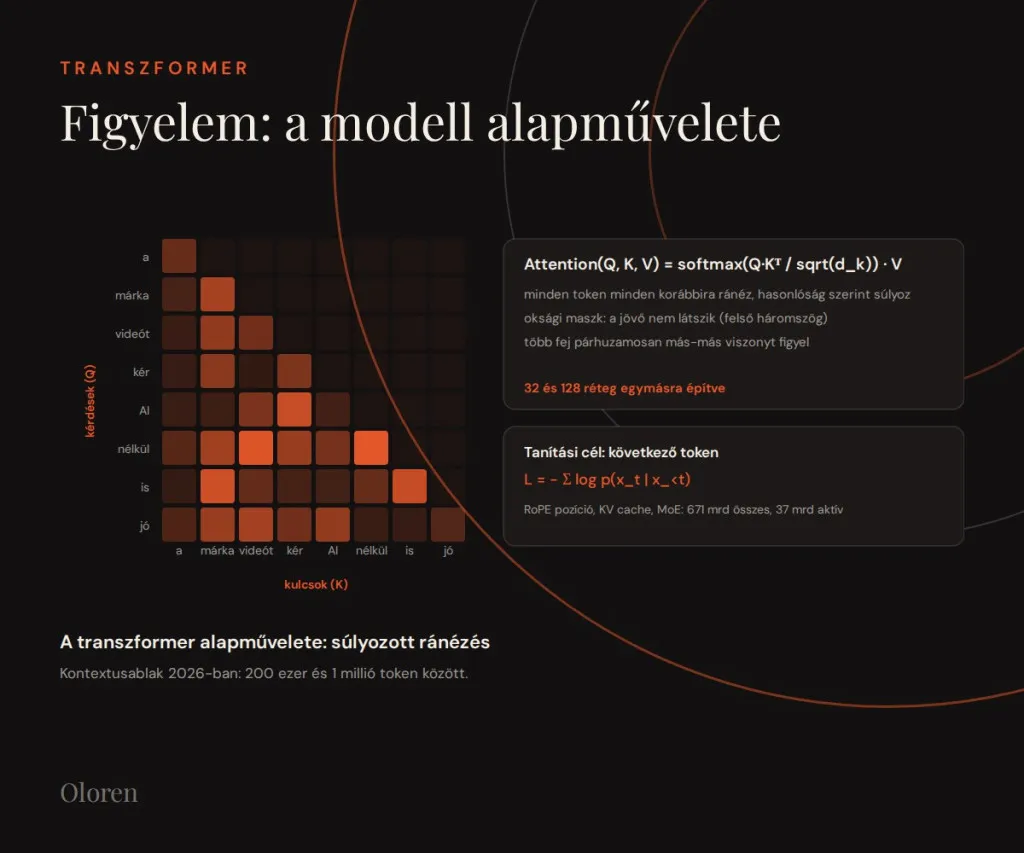
The transformer (Vaswani et al., 2017) computes three vectors for every token: query (Q), key (K), value (V). The attention formula: Attention(Q, K, V) = softmax(Q·K^T / sqrt(d_k)) · V. Every token "looks at" every earlier token, weights them by similarity and carries forward the sum of the weighted values. In a decoder model, a causal mask forbids looking into the future. Multiple heads (multi-head) attend to different relationships in parallel, the block is completed by a feed-forward network, a residual connection and normalisation, and between 32 and 128 of these layers are stacked on top of each other.
Position comes from rotary encoding (RoPE): the Q and K vectors are rotated by an angle proportional to the position, so the dot product depends only on the relative distance. The training objective is the cross-entropy of the next token: L = - sum_t log p(x_t | x_<t). When answering, the model samples token by token (temperature, top-p), keeps the earlier keys and values in a cache (KV cache), and in 2026 the context window ranges between 200,000 and 1 million tokens. Mixture-of-experts (MoE) models activate only a few "expert" sub-networks per token, which is how a 671 billion parameter model can have 37 billion active parameters.
Training stages: pre-training, fine-tuning, RLHF, reasoning
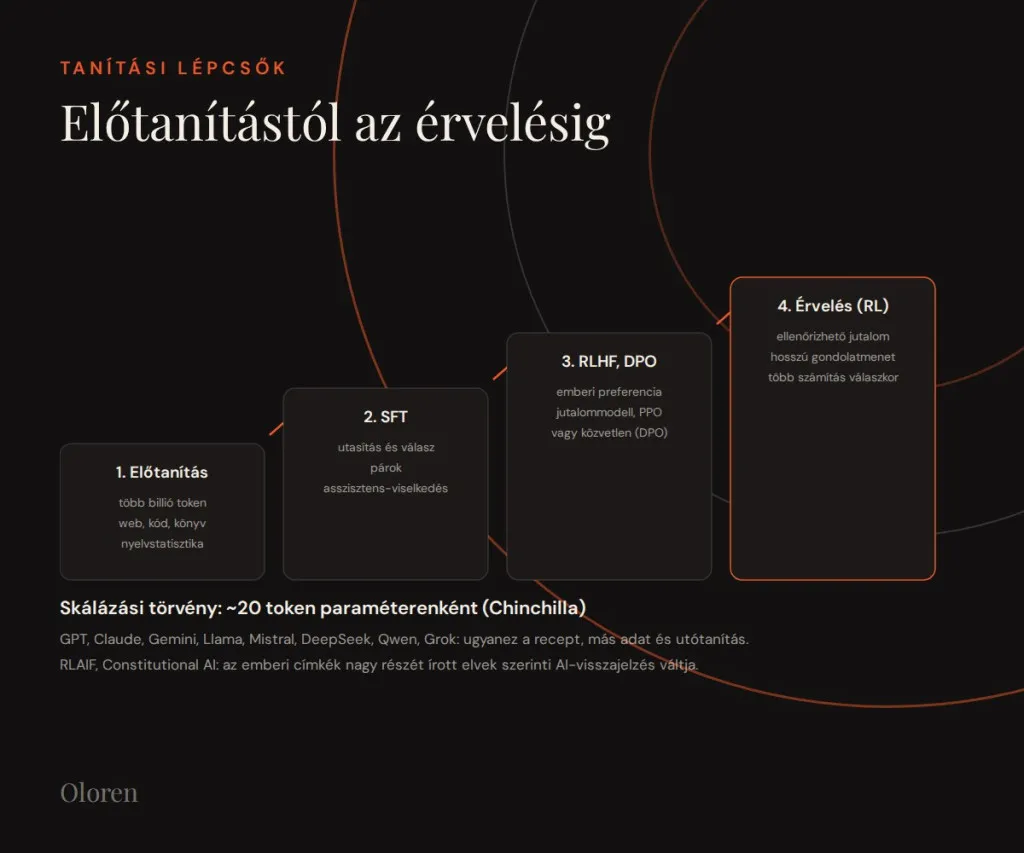
1. Pre-training on trillions of tokens of web text, code and books: the model learns the statistics of language, it is not yet an "assistant". 2. Supervised fine-tuning (SFT) on instruction and response pairs. 3. RLHF (Ouyang et al., 2022): humans rank pairs of responses, a reward model is built from this, and the language model is optimised for the reward with reinforcement learning (PPO), with a KL penalty so that it does not drift away from the SFT model. DPO (2023) skips the reward model and learns the preferences directly; RLAIF and Constitutional AI replace most of the human labels with AI feedback based on written principles. 4. Reasoning models: through reinforcement learning on verifiable rewards (correct maths or code answers), the model learns long chains of thought (DeepSeek-R1, 2025) and uses more computation at response time.
According to the scaling laws (Kaplan 2020, Chinchilla 2022), the loss decreases as a power law with more parameters, data and computation, and compute-optimal training uses roughly 20 tokens per parameter. The frontier models of 2026 (the GPT, Claude, Gemini, Llama, Mistral, DeepSeek, Qwen and Grok families) all follow this recipe; the difference lies in the data, the size, the multimodality and the post-training.
RAG and web search: how the model knows what is true
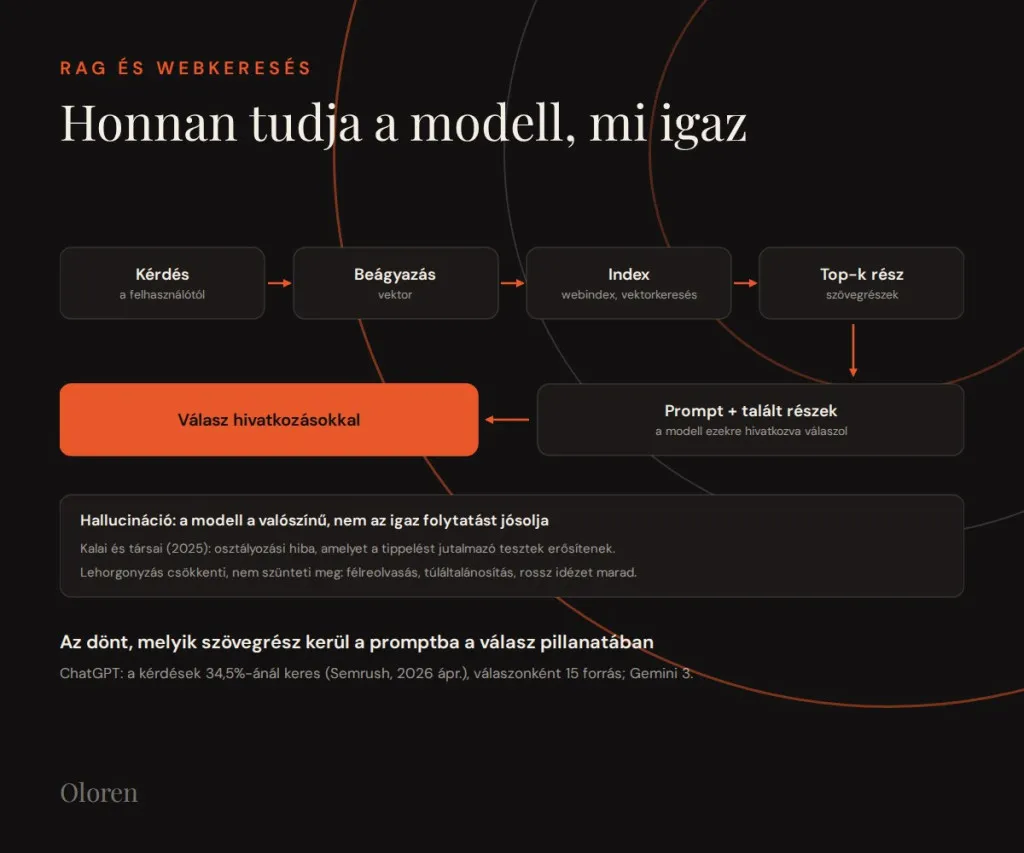
A language model predicts the next likely token, not the truth: that is why it hallucinates. According to Kalai et al. (OpenAI, 2025), hallucination arises as a simple classification error, and benchmarks reinforce it because they reward guessing more than abstaining. The remedy is grounding: retrieval-augmented generation (RAG, Lewis et al., 2020) turns the question into a vector, finds the closest passages in an index, inserts them into the prompt, and the model answers with reference to them. AI search engines (ChatGPT search, Perplexity, Google AI Mode, Gemini, Copilot, Claude, Grok) follow the same scheme, where the retriever is a web index.
This is the essence of GEO: what decides is not what the model "knows" but which passage ends up in the prompt at the moment of the answer. According to Semrush's April 2026 study, ChatGPT uses web search for 34.5 percent of queries, and according to the June 2026 AI Visibility Index it cites an average of 15 sources per answer, Gemini three. The model can still be wrong even when it received a good source: it misreads, overgeneralises, or cites a detail that does not support the claim. That is why a citable, unambiguous, data-backed page is also the best defence against being misquoted.
AI search engines and GEO: how the machine chooses a source
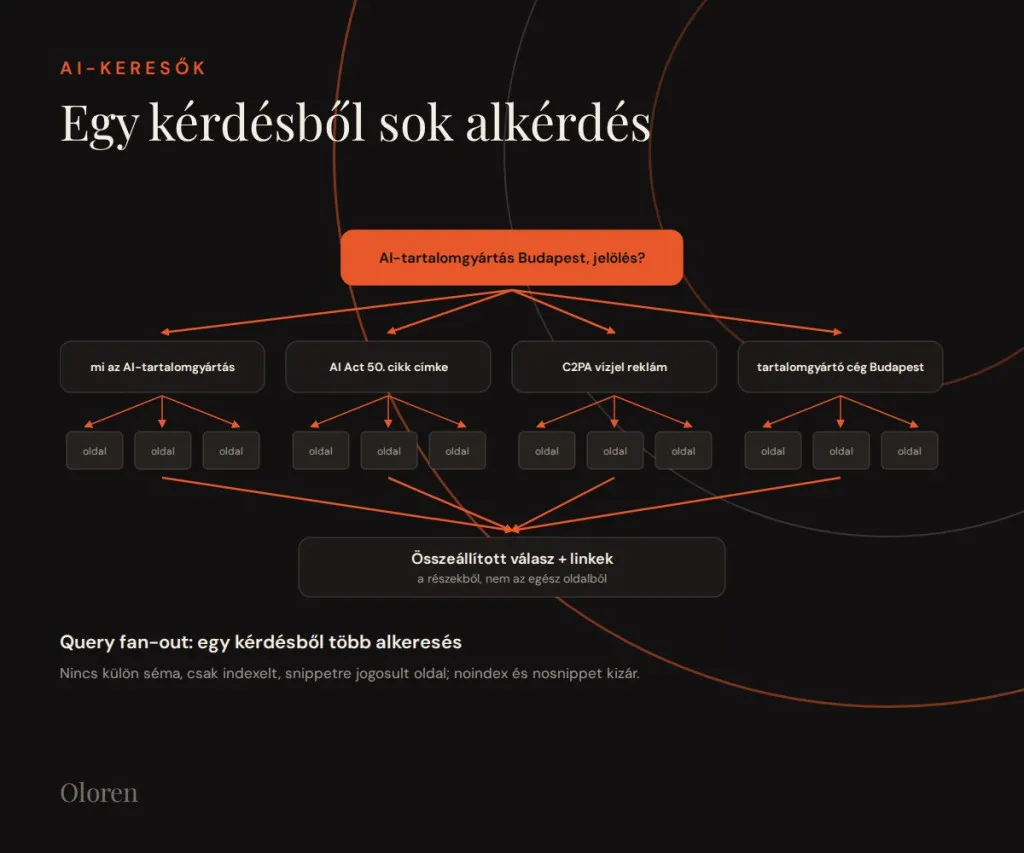
Query fan-out: many sub-questions from one question
According to Google's documentation, AI Overviews and AI Mode use a "query fan-out" technique: they break the user's question into several related sub-searches by topic and data source, and the Gemini-based model assembles and links the answer from the pages found this way. There is no separate technical requirement and no separate structured data to add; the page must be indexed and eligible for snippets, while nosnippet and noindex exclude it. The Google-Extended robots rule only affects the training and grounding of Gemini, not AI Overviews or AI Mode.
The practical consequence: the page competes not for one main keyword but for sub-questions. ChatGPT prompts that trigger a search average 8.7 words (Semrush, April 2026), conversational, multi-intent questions instead of the classic 2 to 4 word keyword. That is why we write a direct answer in the first one or two sentences under every H2 and H3, and why every claim gets a named source and a date.
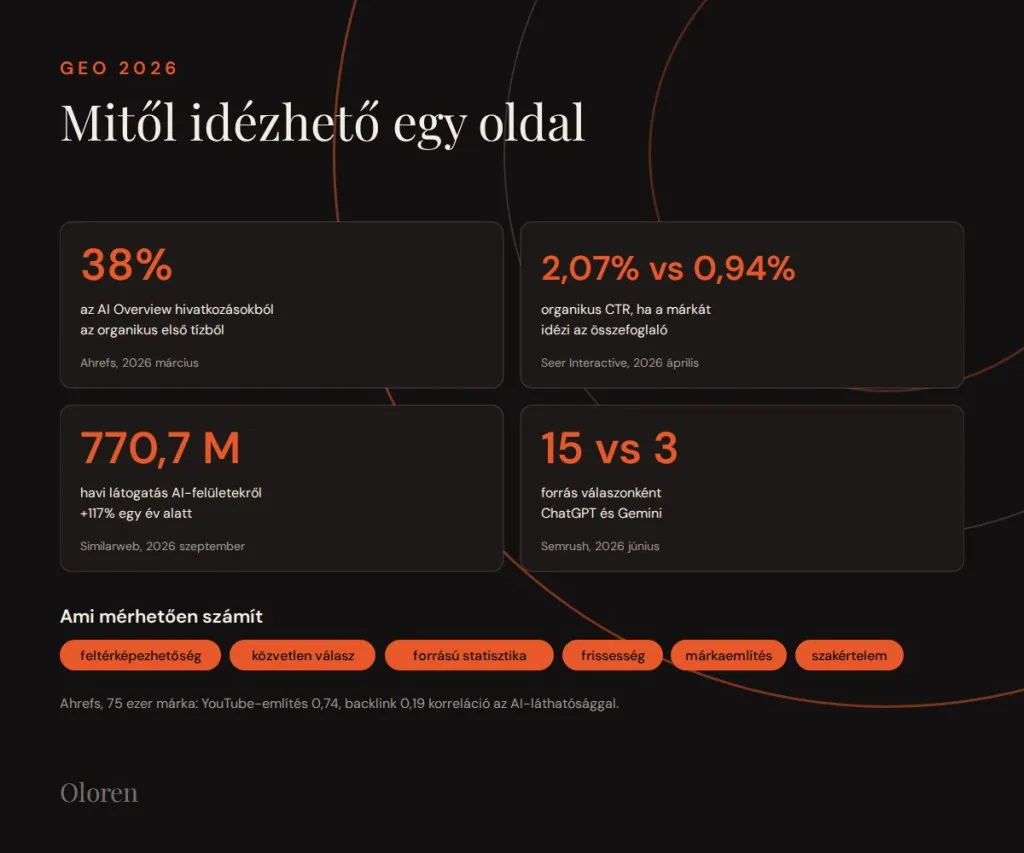
What makes a page citable in 2026
According to Ahrefs' March 2026 study (863 thousand keywords, 4 million AI Overview citations), 38 percent of cited pages rank in the organic top ten, 31 percent beyond position one hundred, and YouTube accounts for 5.6 percent of all citations. Seer Interactive's April 2026 measurement (53 brands, 5.47 million queries) found that with an AI Overview present, organic click-through is 2.36 percent instead of 3.82, but if the brand is cited in the summary, it is 2.07 percent instead of 0.94 for informational queries, more than double. According to Similarweb's September 2026 data, AI platforms sent an average of 770.7 million visits per month to websites, a 117.4 percent increase in one year; of generative AI traffic in May 2026, ChatGPT took 52.7, Gemini 27.3 and Claude 8.9 percent.
What measurably matters: crawlability for AI bots (OAI-SearchBot, Claude-SearchBot, PerplexityBot, Meta-WebIndexer); a direct answer under every heading; statistics, quotes and references with named sources (a 30 to 40 percent visibility increase according to the Princeton GEO study, keyword stuffing nothing); freshness with a visible date; brand mentions on the web, YouTube and Reddit (in Ahrefs' correlation of 75 thousand brands, YouTube mentions score 0.74, backlink count 0.19); author expertise and original research. Schema.org and page speed help indexing; no 2026 study has shown a direct citation effect. We measure this with Ahrefs Brand Radar: AI mentions, citations, estimated impressions and share of voice on ChatGPT, Google AI Overviews, AI Mode, Gemini, Perplexity, Copilot, Claude and Grok. In detail on the SEO, GEO and AEO and GEO optimisation pages.
Labelling and provenance: C2PA, SynthID, platform labels
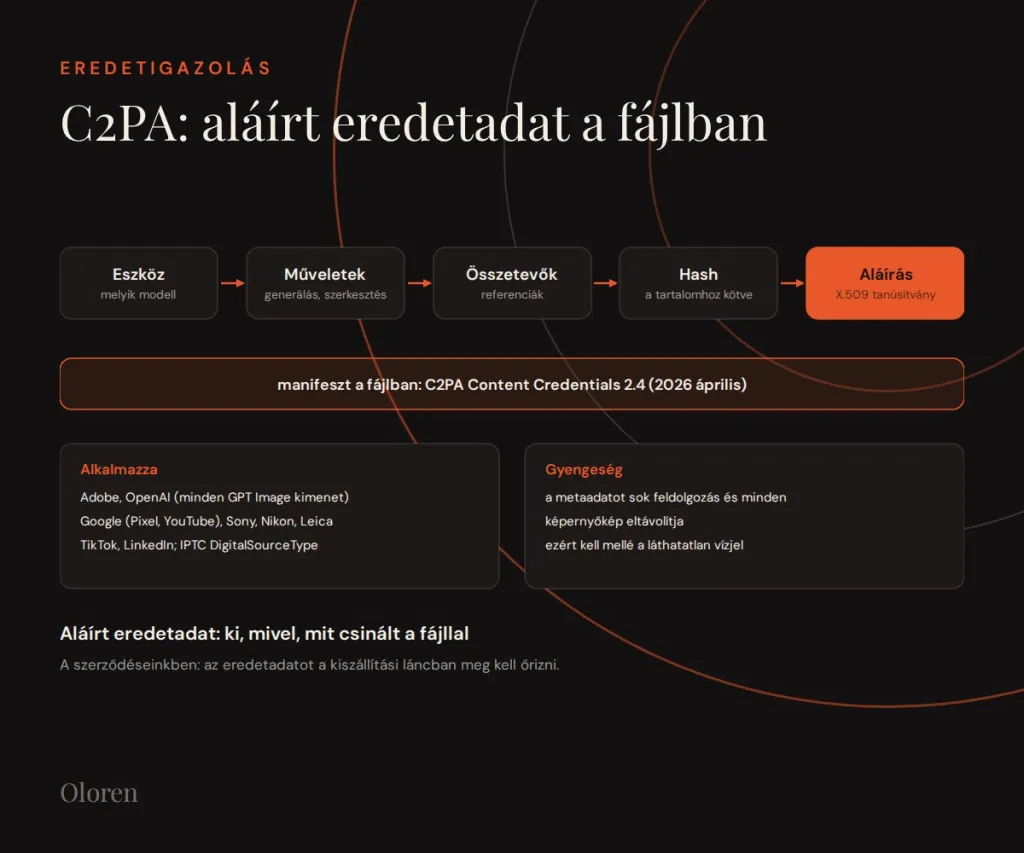
C2PA: signed provenance data in the file
C2PA Content Credentials are a cryptographically signed manifest in the file: they record the tool, the operations and the ingredients, bound to the content by hash and signed with an X.509 certificate. Version 2.4 of the standard was released in April 2026; it is used by Adobe, OpenAI (every GPT Image output), Google (Pixel, YouTube), Sony, Nikon, Leica, TikTok and LinkedIn. In IPTC metadata, the DigitalSourceType field values "trainedAlgorithmicMedia" (created with generative AI) and "compositeWithTrainedAlgorithmicMedia" (edited with generative AI) signal the same thing, and this is what Google's "About this image" and Meta read.
Its weakness is that many processing chains and every screenshot strip the metadata. That is why the EU code of practice pairs it with an invisible watermark, and why our contracts require that provenance data be preserved throughout the delivery chain.
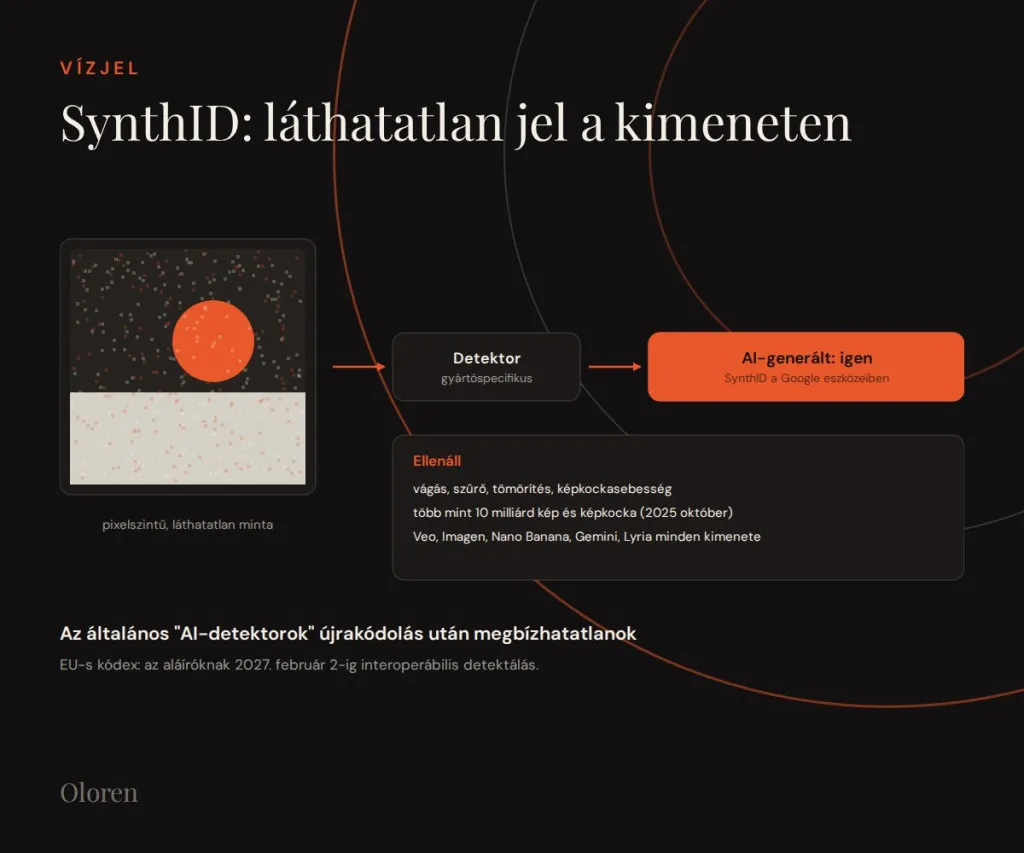
SynthID: invisible watermark
Google's SynthID embeds a pixel-level watermark, invisible to the eye, into images, video, audio and text at the moment of generation, which withstands cropping, filters, compression and frame rate changes. According to the October 2025 SynthID-Image paper, more than 10 billion images and frames have received this mark; every output of Veo, Imagen, Nano Banana, Gemini and Lyria is watermarked, and the Gemini app can verify it. Detectors are vendor-specific: SynthID is recognised by Google's tool, OpenAI's output by OpenAI's classifier; generic "AI detectors" rely on learned artefacts and become unreliable after re-encoding. Signatories of the EU code must provide interoperable detection by 2 February 2027.
Platform labels 2026
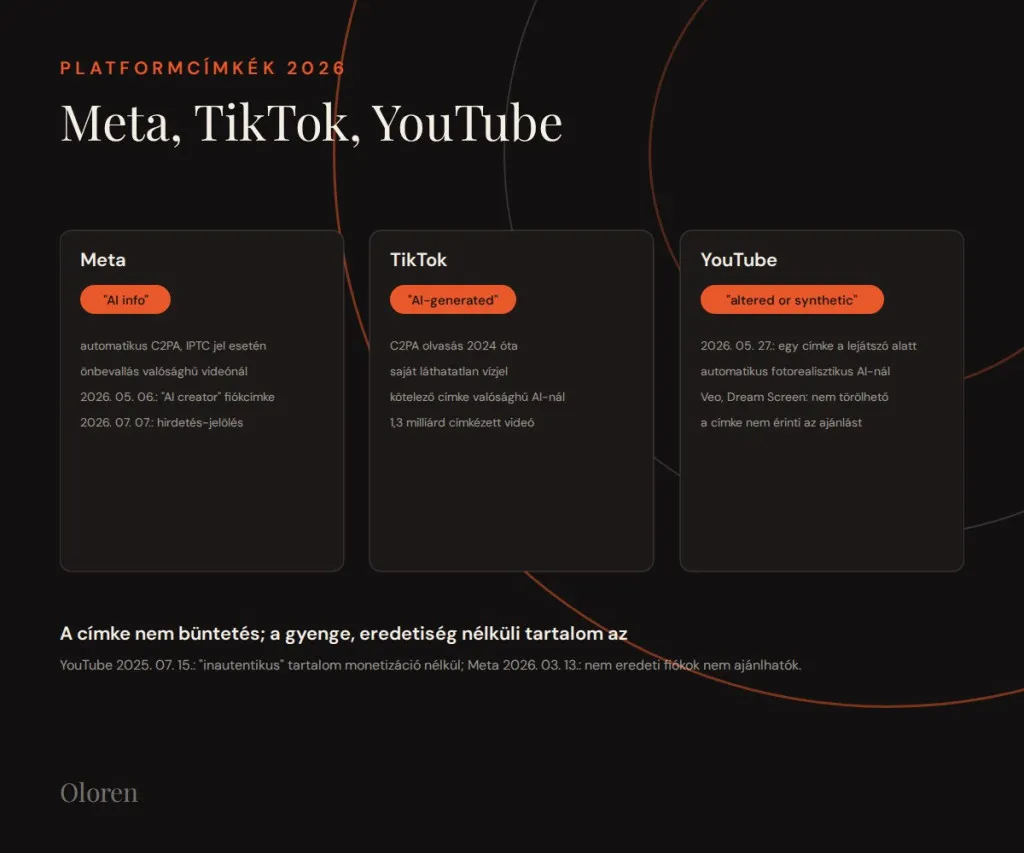
Meta (Facebook, Instagram, Threads): automatic "AI info" label where a C2PA or IPTC signal is present, mandatory self-disclosure for realistic AI video and audio; from 6 May 2026 a voluntary, account-level "AI creator" label on Instagram without a reach penalty; from 7 July 2026 "About this ad" shows for ads whether the creative was made or modified with Meta's or third-party generative tools. TikTok: has read C2PA since 2024, applies its own invisible watermark to AI content, mandatory label for realistic AI images and audio, has labelled more than 1.3 billion videos. YouTube: from 27 May 2026 a single "altered or synthetic content" label under the player (overlaid on Shorts), automatic labelling for photorealistic AI content or C2PA data; the label on Veo and Dream Screen content cannot be removed; the label alone does not affect recommendations or revenue.
What does: from 15 July 2025 YouTube excludes "inauthentic", mass-produced content from monetisation, and from 13 March 2026 Meta makes accounts that mainly post non-original content ineligible for recommendation. So the label is not a punishment; low-quality AI content without originality is.
Legal regulation in 2026: EU, Hungary, the world
EU AI Act, Article 50: in force from 2 August 2026
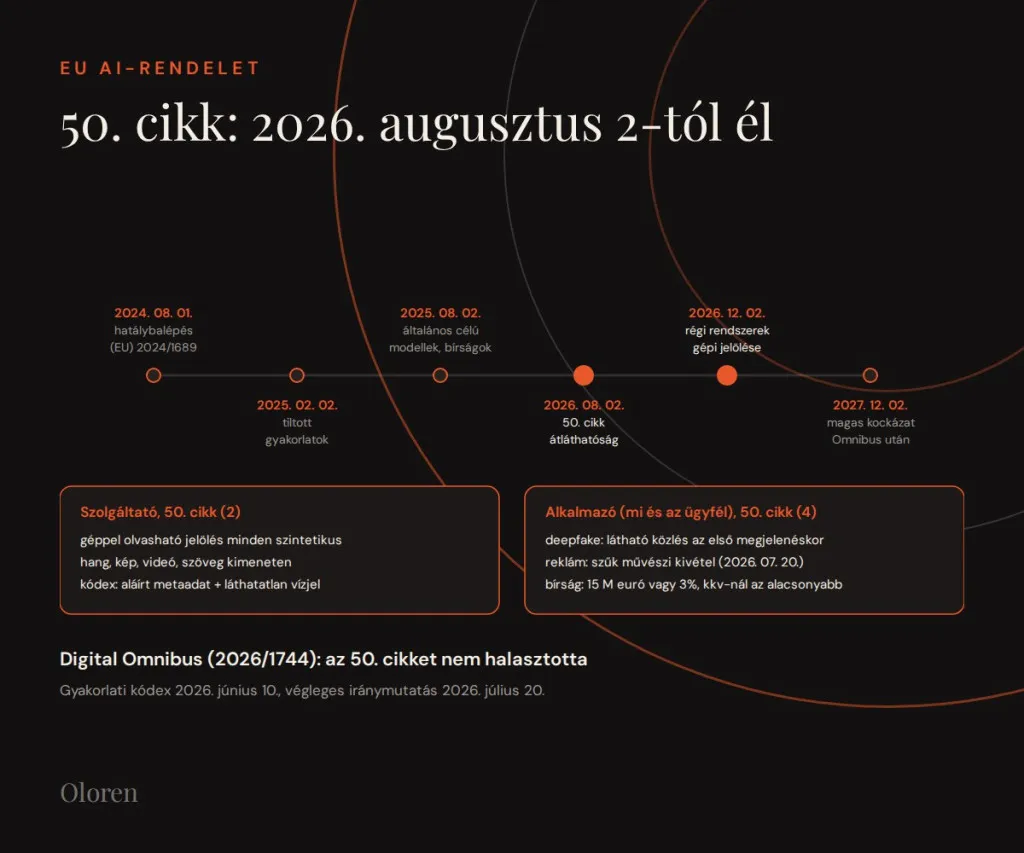
Regulation (EU) 2024/1689 (the AI Act) entered into force on 1 August 2024; the prohibited practices apply from 2 February 2025, the obligations for general-purpose models from 2 August 2025, and the transparency obligations of Article 50 from 2 August 2026. The Digital Omnibus (Regulation (EU) 2026/1744), in force since 27 July 2026, did not postpone Article 50; it only granted a grace period until 2 December 2026 for the machine-readable marking of generative systems already on the market before 2 August 2026, moved the deadlines for high-risk systems to 2 December 2027 and 2 August 2028 respectively, and from 2 December 2026 bans "nudification" and child-abusing image generation systems.
Article 50(2) imposes an obligation on the provider: synthetic audio, image, video and text output must be marked in a machine-readable format and made detectable. Paragraph (4) applies to the deployer, that is, to us and our clients: whoever creates or modifies a deepfake (content resembling an existing person, object, place or event that appears authentic) must disclose that it was artificially generated; for artistic, satirical or fictional works, disclosure in a way that does not hamper the enjoyment of the work is sufficient. The Commission's code of practice published on 10 June 2026 expects at least two machine techniques from providers (signed C2PA-type metadata and an invisible watermark), and from deployers a visible, uniform EU icon or an "AI-generated" or "AI-modified" notice at first display. The final guidelines of 20 July 2026 treat advertising narrowly: purely informational or commercial content cannot rely on the artistic exception, and an AI ad showing the product differently from reality requires a deepfake label. The fine for infringing Article 50 is up to 15 million euros or 3 percent of global turnover, for SMEs the lower of the two.
Copyright: who is the author, and what is protected?
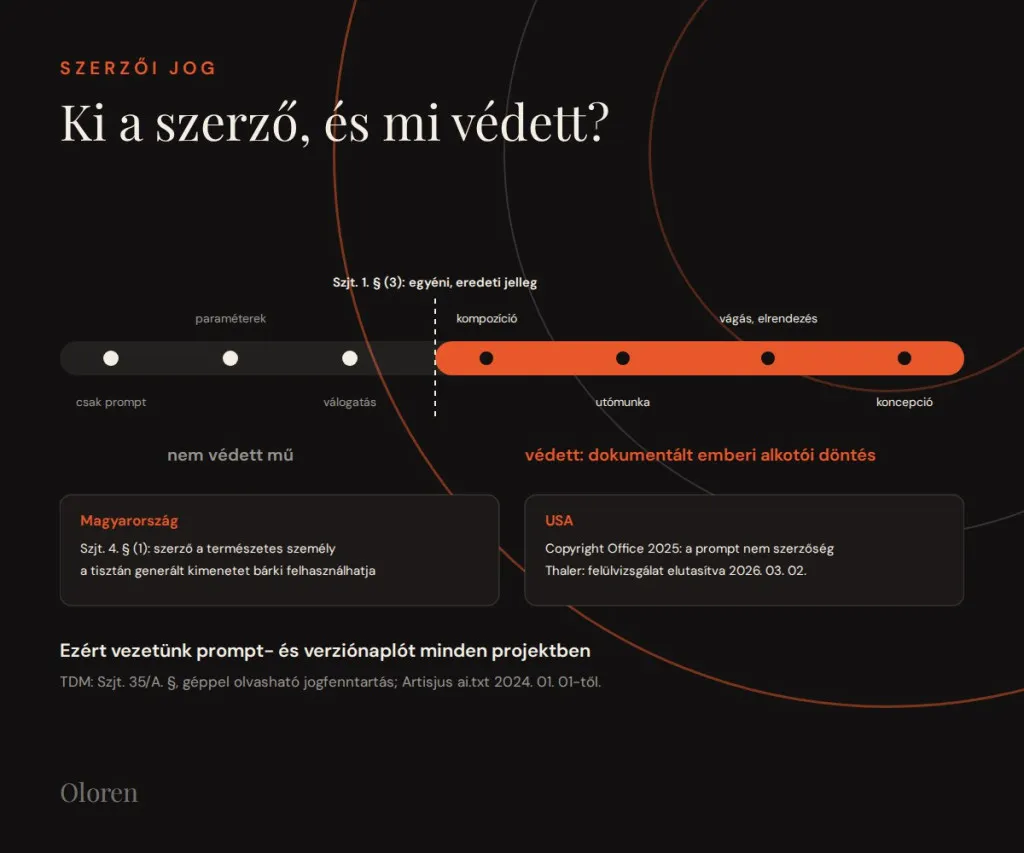
Under Section 1(3) of the Hungarian Copyright Act (Act LXXVI of 1999), protection requires an individual, original character stemming from the author's intellectual activity, and under Section 4(1) the author is the person who created the work, that is, a natural person. Purely machine-generated output is therefore not a protected work: anyone, including a competitor, may use it freely. The rule is the same in the United States: according to the Copyright Office's January 2025 report, a prompt alone does not establish authorship, and in the Thaler case the Supreme Court denied review on 2 March 2026, so the human authorship requirement is final.
What makes the result protectable is documented human creative decision-making: concept, composition, iterative direction, selection, post-production, editing, arrangement. That is why we keep a prompt and version log in every AI project, and why the finished material always contains a human creative layer. In the EU, Article 4 of Directive 2019/790 (Section 35/A of the Hungarian Copyright Act) permits text and data mining unless the rightholder has reserved their rights in a machine-readable way; Artisjus made a collective reservation with an ai.txt file from 1 January 2024. The European Parliament adopted the Voss report on 10 March 2026 (remuneration, transparency, rebuttable presumption of use), the Commission launched a consultation on 13 May 2026, and the first generative AI copyright case is pending before the Court of Justice of the EU on a Hungarian referral (Like Company v Google, C-250/25, hearing on 10 March 2026).
Hungarian authority, personality rights, data protection
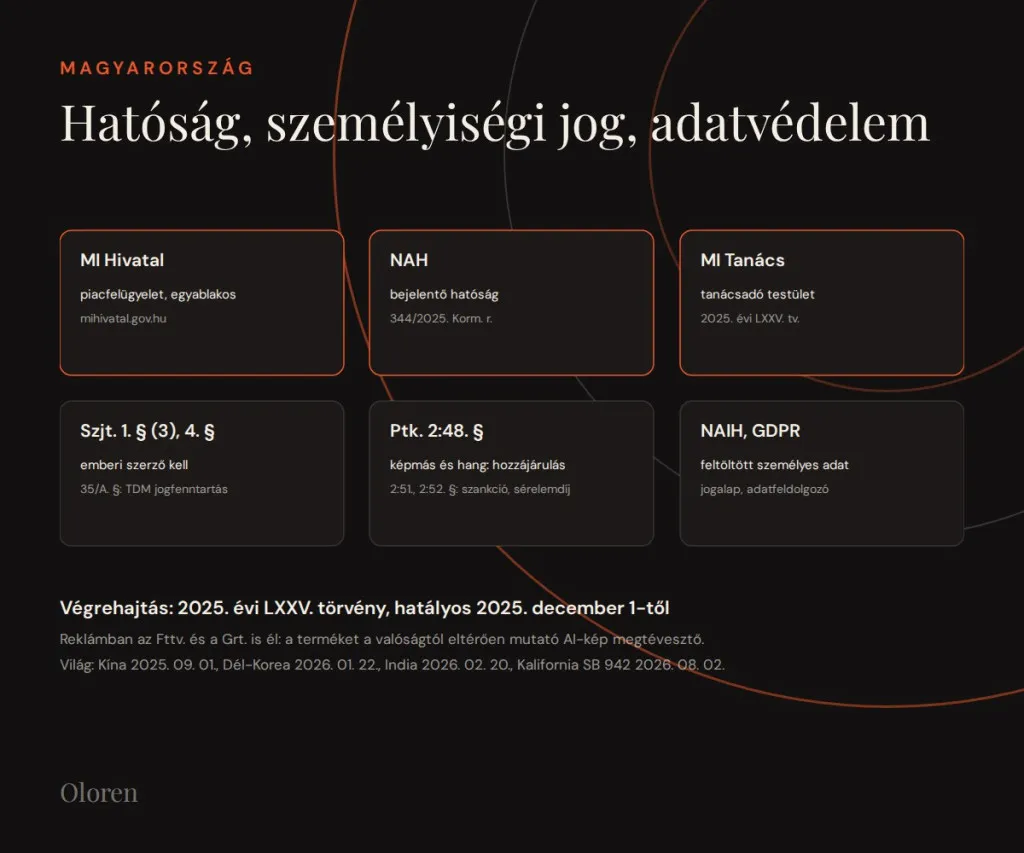
Act LXXV of 2025 (in force since 1 December 2025) and Government Decree 344/2025 (X. 31.) implement the AI Act: the notifying authority is the National Accreditation Authority, and the market surveillance authority and single point of contact is the Artificial Intelligence Office (mihivatal.gov.hu), which also operates the regulatory sandbox; alongside it, the Hungarian Artificial Intelligence Council provides advice. According to the Office's guidance, the provider must give a textual, visual or audio notice of AI use no later than the first interaction, and must mark the output in a machine-readable form.
Likeness and voice require consent under Section 2:48(1) of the Hungarian Civil Code, and infringement carries objective sanctions (Section 2:51) and damages for injury to feelings (Section 2:52). Whoever uploads a client photo or an identifiable person to a generator is processing personal data: this requires a GDPR legal basis and data processor terms, and the Hungarian data protection authority (NAIH) already imposed a fine of 250 million Ft in 2022 for AI-based voice analysis. In advertising, the general rules of the Hungarian Unfair Commercial Practices Act and the Advertising Act apply: an AI image showing the product differently from reality is misleading, even if labelled. The rest of the world is heading the same way: China requires explicit and implicit labels from 1 September 2025, South Korea from 22 January 2026, India from 20 February 2026; in the United States the TAKE IT DOWN Act requires platforms to remove content within 48 hours from 19 May 2026, California's SB 942 requires metadata marking from 2 August 2026, and the NO FAKES Act cleared the Senate Judiciary Committee in June 2026.
The court cases of 2025 and 2026 that are shaping practice
| Case | Court, date | Ruling and current status |
|---|---|---|
| Getty Images v. Stability AI | England, High Court, 4 November 2025 | the model is not an "infringing copy" because it does not store the works; limited trademark success; Getty may appeal |
| GEMA v. OpenAI | Munich Regional Court I, 11 November 2025 | memorising lyrics is reproduction, not covered by the TDM exception; appeal pending before the Munich Higher Regional Court |
| GEMA v. Suno | Munich Regional Court I, 31 July 2026 | training, memorisation, output and communication to the public all infringing; the fair use argument rejected |
| Bartz v. Anthropic | N.D. Cal., 23 June 2025 and 22 July 2026 | training on lawfully acquired books is fair use, pirated copies are not; 1.5 billion dollar settlement approved |
| Kadrey v. Meta | N.D. Cal., 25 June 2025 | fair use on the evidence presented, expressly not a precedent |
| Thomson Reuters v. Ross | D. Del. February 2025; 3rd Cir. hearing 11 June 2026 | no fair use for non-generative legal AI; appeal decision expected by the end of 2026 |
| NYT and others v. OpenAI, Microsoft | S.D.N.Y., consolidated proceedings | most of the claims survived the motion to dismiss; summary judgment phase from 4 September 2026 |
| Disney, Universal, Warner v. Midjourney | C.D. Cal., June and September 2025 | generation of protected characters; motions until 23 November 2026, trial in 2027 |
| Thaler v. Perlmutter | US Supreme Court, 2 March 2026 | review denied: AI cannot be an author |
| Like Company v. Google | Court of Justice of the EU, C-250/25, Hungarian referral | chatbots and press content, training as reproduction, TDM exception; judgment expected in 2027 |
The pattern is clear: in the United States, training on lawfully acquired material has so far qualified as fair use, pirated sources have not; in Europe, memorisation and similar output are infringement, and the legality of training depends on the source. In advertising production we therefore think from the output side: we do not generate recognisable protected works, characters or performers' voices, and we choose tools trained on licensed data, with enterprise terms and legal indemnity, wherever these are available.
Glossary
| Term | Meaning |
|---|---|
| Prompt | A text or image instruction from which the model generates. Split into tokens, it enters the network as vectors. |
| Token | The model's smallest unit: a word fragment, an image patch or an audio frame. |
| Embedding | The numeric vector representation of a token or an image; similar meaning means nearby vectors. |
| Latent space | The internal representation compressed by the VAE, where diffusion runs. |
| Diffusion | Adding noise and removing it step by step; the basis of today's image generators. |
| Flow matching | A velocity field learned along a straight path between noise and image; fewer steps. |
| DiT, MMDiT | Diffusion transformer; the variant that handles image and text tokens in joint attention. |
| Guidance (CFG) | Amplifying the effect of the prompt using the difference between conditional and unconditional prediction. |
| Seed | The random number seed of the initial noise; the same seed and settings give the same image. |
| ControlNet, IP-Adapter, LoRA | Control branches and small adapters for locking composition, reference image and style. |
| 3D VAE | An autoencoder that compresses video in space and time. |
| Neural codec, RVQ | A compressor that splits audio into integer tokens; the input of music models. |
| Transformer, attention | The building block of language models and most generative models; tokens "looking at" each other with weights. |
| RLHF, DPO | Post-training based on human preferences; raising the model to be an "assistant". |
| RAG | Retrieval-augmented generation: the model answers based on retrieved passages, with citations. |
| Hallucination | A plausible but false statement; a natural error of prediction, reducible with grounding. |
| GEO, AEO | Generative and Answer Engine Optimization: making AI search engines cite our page. |
| Query fan-out | Splitting a question into several sub-searches in AI search engines. |
| C2PA | A signed provenance data standard inside the file. |
| SynthID | Google's invisible watermark for generated images, video, audio and text. |
| Deepfake (AI Act Article 3(60)) | Generated or manipulated content that resembles an existing person, object, place or event and appears authentic. |
| Provider and deployer | The two actors of the AI Act: the one who develops the system and the one who uses it; the advertising producer is a deployer. |
| TDM exception | Permission for text and data mining under copyright law, which can be excluded by a machine-readable reservation of rights (Hungarian Copyright Act, Section 35/A). |